
When building a log house, there are two great choices: traditional pine logs, or spruce logs,...
The short answer: yes. A laminated log is solid wood glued from a few lamellas, and the glue Honka uses is low-emission and M1-approved, the strictest Finnish class for indoor emissions. The glue joints let moisture through, so the wall behaves like a log cut from one piece: it helps hold indoor humidity in the healthy 30 to 55% range. Here is what is in the wall, and what it does to the air you breathe.
What a laminated log is
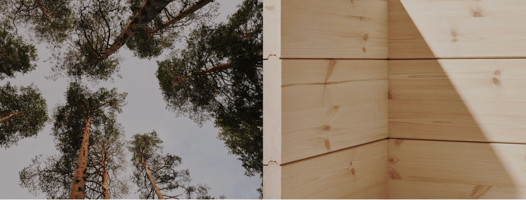
A modern Honka log is made by gluing two or more pieces of wood, called lamellas, together and planing the blank into a finished wall log. Laminating does two things a one-piece log can't: it keeps the log from warping and cracking as it dries, and in Honka's non-settling logs it lets the central lamellas run vertically. Wood barely shrinks along its length, so a log with a vertical core doesn't settle.
Honka USA builds with the non-settling Honka Fusion+ log. Its core is slow-grown Nordic Scots pine with the grain running vertically, and the pine carries the structure. The faces are spruce, with the grain running horizontally, for the look.
What the glue is, and what it releases
Honka's log glue is low-emission and M1-approved, which means it does not release harmful emissions into the indoor air. M1 is Finland's emission classification for building materials, created in 1996. It sets strict limits on what a material may release into a room: volatile organic compounds (VOCs), formaldehyde and ammonia.
The glue joints are permeable to moisture. That matters for health as much as for durability: the wall can still take in and give back water vapor across its whole thickness, the same way a traditional solid log does.
The wood itself is in the same class. According to studies by VTT, Finland's national technical research centre, untreated logs made of pine and spruce can be equated to the lowest emission class, M1.
What the wood does to indoor air
It balances humidity. Solid wood absorbs moisture when the air is damp and releases it when the air is dry. In a solid log house, indoor relative humidity naturally settles in the 30 to 55% range, where bacteria, viruses, mold spores and dust mites do poorly. (Source: VTT, Improving Indoor Climate and Comfort with Wooden Structures, 2001.)
It is naturally antibacterial. Nordic pine and spruce contain resin compounds and terpenes that have been shown to reduce bacteria on surfaces and in indoor air. Terpenes are also what gives a log home its fresh wood smell. Pine contains more of them than spruce. (Source: Tiina Vainio-Kaila, Antibacterial properties of Scots pine and Norway spruce, Aalto University doctoral dissertation, 2017.)
A note for sensitive people: terpenes are natural VOCs. Honka's own guidance is that people who are highly sensitive to organic compounds should consider spruce-faced logs and spend time in a log home before deciding.
Tight walls, filtered air
A healthy house keeps pollutants and moisture from getting into the structure uncontrolled, then brings in clean air on purpose. Honka log walls have factory-installed sealing strips between every log, and airtightness measurements in Honka homes typically show an air leakage rate below 1.0, with results as low as 0.1. In a house that tight, Honka recommends controlled mechanical ventilation that brings in filtered fresh air and removes stale air.
Finishes count too
The healthiest wall surface is the log itself, left open to the room so it can do its work with humidity. Where you do finish the wood, choose M1-approved surface treatments. Avoid very dark colors on walls that take full sun: the surface can get hot enough to push resin out of the wood.
The takeaway
- A laminated log is solid wood. The glue is low-emission and M1-approved.
- The glue joints are breathable, so the wall still balances humidity like a one-piece log.
- Untreated pine and spruce logs rate with the lowest emission class, M1.
- Pine and spruce are naturally antibacterial; spruce faces are the gentler choice for very sensitive people.
- Tight log walls plus mechanical ventilation give you control over the air you breathe.
What’s smarter than a smart home? Nature, of course.
Further reading
Why Solid Timber: how a solid timber wall holds heat and humidity, and how it compares with rammed earth and ICF.
Pine or spruce for a log home? The real differences: heartwood, knots and color.
The Honka Process Timeline: all 20 steps, from your budget to raising day.
Sources: Honkarakenne, HonkaLook product cards "Honka laminated logs" and "Honka Healthy House"; VTT Publications P431 (2001); Aalto University (2017); Finnish emission classification of building materials (M1), rakennustieto.fi.